Time-Limited Coupons: Psychology That Drives Action
Deadlines focus attention. Time-limited coupons turn that attention into action by combining urgency with clear, immediate value.
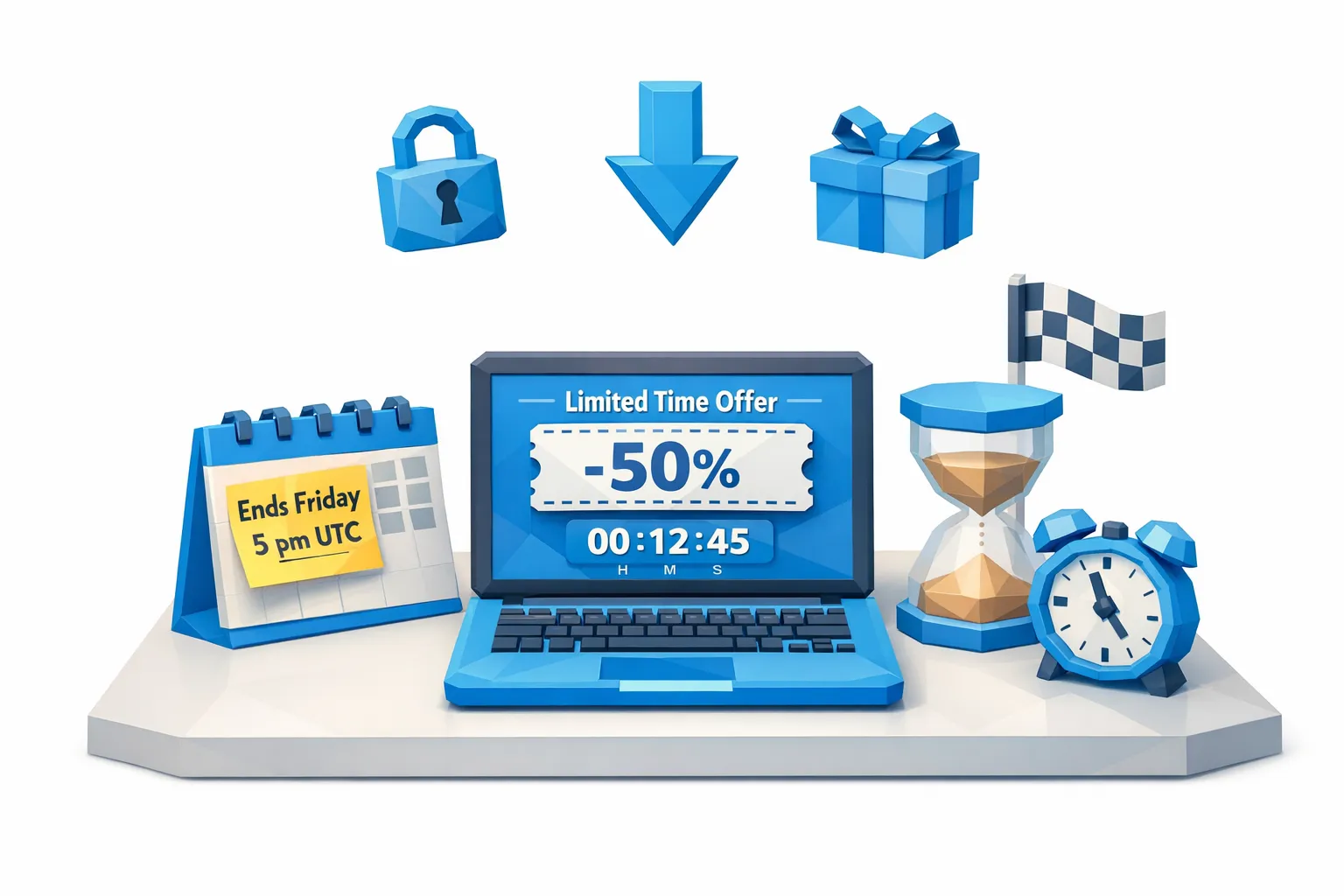
Deadlines focus attention. Time-limited coupons turn that attention into action by combining urgency with clear, immediate value. For SaaS and digital products, they can accelerate upgrades, annual plan conversions, and reactivation campaigns without bloating your roadmap or adding onboarding friction. The difference between an offer that gets ignored and one that doubles conversions comes down to psychology and execution.
The psychology behind time-limited coupons
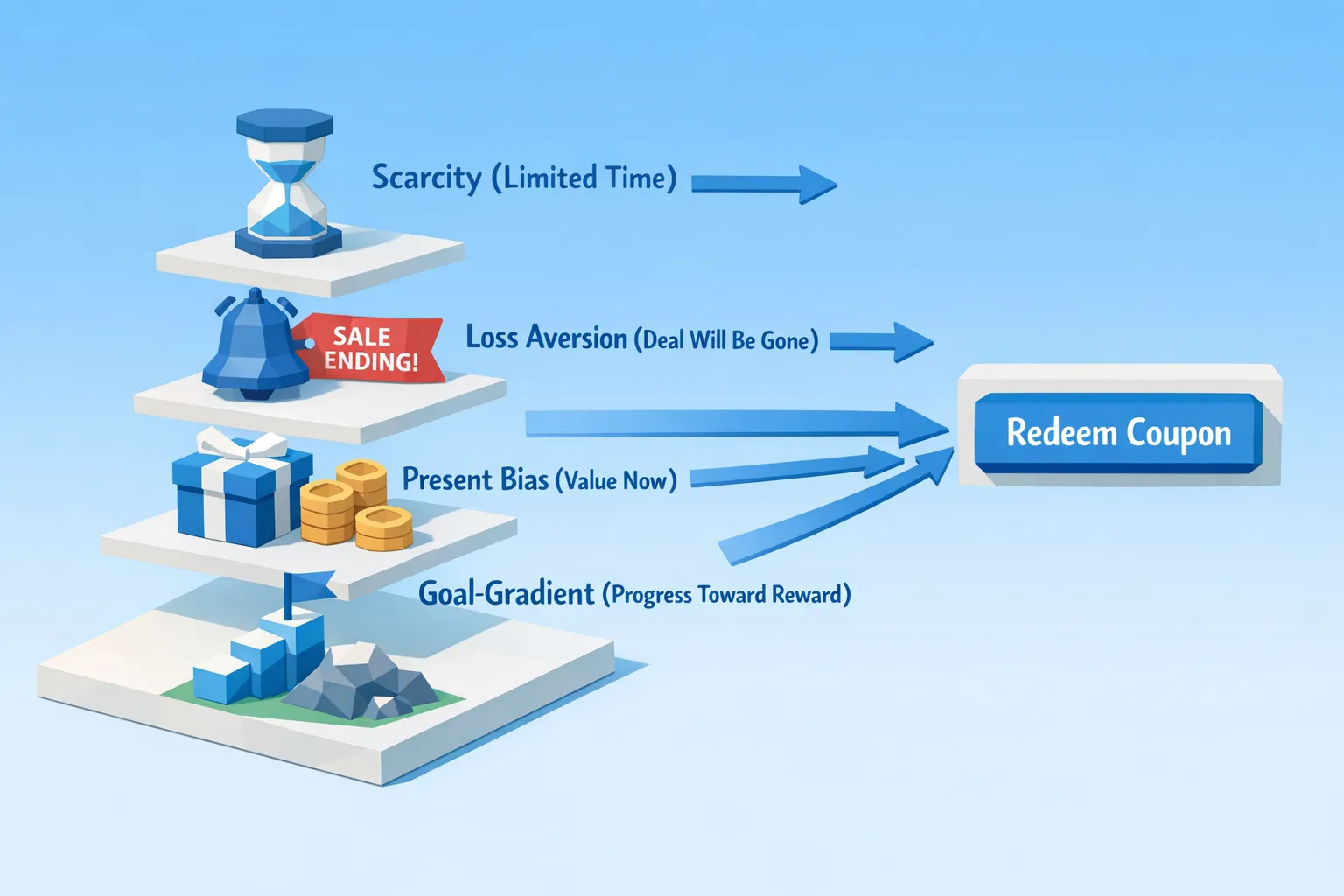
Time limits work when they align with how people actually make decisions under uncertainty and limited attention. Four principles matter most.
Scarcity increases perceived value
When something is available for a short time, we infer it is more valuable or at least more worthy of attention. Classic experiments showed that identical cookies were rated as more desirable when in short supply compared to abundant supply, a well known scarcity effect documented in social psychology research (Worchel, Lee, and Adewole, 1975, Journal of Personality and Social Psychology, doi:10.1037/0022-3514.32.5.906).
What this means for coupons: spell out the constraint. If it ends Friday, say it ends Friday. If it is limited to the first 250 redemptions, say so and keep the limit truthful.
Loss aversion makes missing out feel costly
People weigh losses more heavily than equivalent gains. Prospect Theory explains why the pain of losing a deal can loom larger than the pleasure of saving the same amount later (Kahneman and Tversky, 1979, Econometrica). A time-limited coupon reframes inaction as a potential loss.
What this means for coupons: highlight what the user will miss by waiting, for example, “Save 20 dollars today, price reverts to 49 dollars per month tomorrow.”
Present bias favors rewards now over later
We discount future benefits more steeply than near term ones, a pattern documented across behavioral economics (Frederick, Loewenstein, and O’Donoghue, 2002, Journal of Economic Literature). A time box makes the reward immediate and concrete.
What this means for coupons: remove friction to redeem now. One click apply on checkout, simple codes, and no hoops.
Goal‑gradient accelerates behavior near a finish line
People work faster as they approach a goal. In loyalty contexts, showing progress increases velocity toward completion (Kivetz, Urminsky, and Zheng, 2006, Journal of Marketing Research, 43(1):39–58). A visible expiration acts like a finish line.
What this means for coupons: make the deadline visible and specific, for example, “Offer ends in 2 days, 14 hours.” Even better, show the exact timestamp in the user’s local time zone.
| Principle | Practical tactic | Metric to watch | Risk if misused |
|---|---|---|---|
| Scarcity | Specific end date or redemption cap | Redemption rate | Perceived manipulation if the cap or date moves repeatedly |
| Loss aversion | Copy that frames the cost of missing out | Click to checkout | Fear based messaging, brand damage |
| Present bias | Frictionless redemption, auto apply where possible | Time to redeem | Extra steps kill urgency |
| Goal‑gradient | Visible countdown or clear deadline timestamp | Completion rate by last 24 hours | False urgency triggers complaints |
Note on ethics and compliance: urgency claims must be truthful and substantiated. The U.S. Federal Trade Commission requires advertising claims to be accurate and not misleading. See the FTC’s guidance on advertising and marketing basics for small businesses, which emphasizes truthful offers and clear terms. The UK Competition and Markets Authority also provides principles for using urgency and price reduction claims in online shopping, which discourage rolling or fake countdowns. Review the FTC’s advertising basics and the UK CMA principles for urgency claims before shipping campaigns.
When time-limited coupons work best in SaaS
Context matters as much as the offer. Below are common, high leverage use cases.
1) Trial to paid conversion
Trigger a short window upgrade incentive when a user hits an activation milestone, for example, imports data, invites a teammate, or uses a key feature for the third time. The value proposition is salient, and the user has evidence your product works for them.
Example: “Upgrade in the next 48 hours to keep unlimited exports, save 25 dollars on month one.”
2) Annual plan upgrade from monthly
Offer a time boxed discount or bonus for locking in the annual plan. The decision reduces cognitive load and payment friction for the next 12 months.
Example: “Switch to annual by Sunday, get 2 months free and priority support onboarding.”
3) Reactivation of churned or paused accounts
Reach out with a tightly scoped comeback window that aligns with a new feature release, an integration they asked for, or tax season budgeting.
Example: “We added SOC 2 reports. Rejoin this week and your first month is 50 percent off.”
4) Expansion add ons
When you ship meaningful enhancements, use a short lived coupon to spark adoption among power users.
Example: “Enable the AI transcription add on today only, save 30 percent on your first 3 hours.”
5) Seasonal budgets and procurement cycles
Quarter end and fiscal year end can be natural deadlines, but avoid blanket claims that look like pressure tactics. Be explicit and fair.
Example: “Q1 startup discount ends March 31, applies to companies under 10 full time employees.”
Crafting ethical urgency that builds trust
Short spikes in conversion are not worth long term brand erosion. Use clear rules.
- Be precise, and stick to the deadline. If you end Friday at 5 pm UTC, end Friday at 5 pm UTC.
- State the terms on the coupon itself. Eligible plans, regions, stackability, and expiration.
- Cap frequency. Overuse trains customers to wait for discounts.
- Use segmentation so existing customers do not see new user only coupons.
- Provide a brief grace policy through support, for example, honor within 24 hours for documented issues.
- Make dismissal easy, and ensure accessibility of the popup content, including keyboard navigation and screen reader labels.
For more detail on collecting user input ethically during promotions, see our guide on Maximizing Feedback Collection.
Offer design: what to say, where to show it
Copy patterns that work
- Benefit first, then deadline: “Export without limits, upgrade by Friday and save 25 dollars.”
- Anchor price and reversion: “19 dollars per seat today, returns to 29 dollars per seat tomorrow.”
- Bonus over discount for high trust: “Upgrade in 48 hours, get a free onboarding session.”
- Specificity over hype: “Ends Jan 31 at 5 pm UTC. Applies to Starter and Growth plans only.”
Keep the headline short, under 10 words if possible, and put the expiry in the headline or the first line.
Visuals and placement
- Put the deadline near the primary CTA.
- Show the exact expiration date and time, use the user’s local time if you display a timestamp.
- Keep the path to redemption one click away. If a code is needed, auto copy on click.
- Place the message where intent is highest, for example, pricing page, in app upgrade modal, or the moment after an activation event.
Redemption friction to remove
- Avoid account creation walls on checkout for current users.
- Pre select the discounted plan when they land from the message.
- Keep codes simple and error tolerant. Consider appending via URL when possible.
Experiment blueprint: prove incremental revenue, not just redemptions
Time limits make attribution look good, because redemptions bunch up near the deadline. That does not prove lift. Use a disciplined test design.
- Define a clear baseline cohort. For example, all trial users who reached activation milestone X last month.
- Randomly assign users to control and variant before exposure to the coupon.
- Test one lever at a time: 24 hours vs 72 hours, 20 percent vs 30 dollars off, discount vs bonus.
- Run an intention to treat analysis. Count everyone assigned, not just those who saw or clicked, to avoid exposure bias.
- Include a cooldown observation window to capture late conversions without the coupon.
Key metrics to track:
- Redemption rate and absolute conversions
- Incremental revenue versus control, net of discount cost
- Time to conversion and plan mix shift
- 90 day retention and refund rates of redeemers versus control
- Cannibalization, conversions that would have happened at full price
Deadlines can also reduce procrastination and improve completion rates, a pattern supported by research on deadlines and performance in behavioral science (Ariely and Wertenbroch, 2002, Psychological Science). Validate this effect in your own funnel rather than assuming.
Practical examples for SaaS teams
- Product led growth tool: Show a coupon for upgrading to Pro within 48 hours once a user exports their first report. The value is clear and the timing is earned by usage.
- Developer API: Offer 25 percent off the first 50 thousand calls when a user completes the API quickstart. Limit by time and usage, which caps downside while encouraging real adoption.
- Collaboration app: When a workspace reaches 5 active users, display an offer to switch to annual at 2 months free for 72 hours. The trigger aligns with demonstrated team fit.
- Education platform: Tie a 3 day upgrade bonus to a new certification track release and target only users who viewed that track.
Implementation tips with ModalCast
ModalCast helps you announce, target, and learn from offers without adding complexity to your codebase.
- Create a focused post in your ModalCast feed that clearly states the benefit and the expiration.
- Target the message to relevant pages or audiences you define, so the right people see the right coupon.
- Publish at the moment of highest intent, then remove the post promptly when the offer ends. You can prepare copy ahead of time with Draft Posts so you are ready to go.
- Pair the offer with a quick “Not for me” microsurvey for dismissals, for example, “Too expensive,” “Wrong timing,” “Feature mismatch.” See our guide on microsurveys.
- After the promotion, post a short update in the widget summarizing what is next, or invite users to join a list for future offers. Keep the loop tight.
If you are new to ModalCast, here is the setup guide. For broader strategy on promotions, see Driving Conversions with ModalCast.
Coupon accounting: a simple way to judge ROI
A discount that boosts conversions but hurts unit economics is not a win. Use a quick back of the envelope check.
- Incremental revenue = revenue from coupon cohort minus expected revenue without coupon.
- Discount cost = sum of discounts granted plus any incremental costs of goods.
- Net impact = incremental revenue minus discount cost.
- Quality check = compare 90 day gross churn and support tickets of redeemers versus control.
If net impact is positive and quality holds within your tolerance, scale cautiously. If net impact is negative or quality drops, refine audience, timing, or offer.
Common pitfalls to avoid
- Rolling deadlines with new countdowns every day. This erodes trust.
- Meaningless discounts, for example, 5 percent off a 10 dollar plan. The savings must feel real.
- Mismatch between copy and checkout. If the price does not reflect the promised discount immediately, users abandon.
- Overlapping offers that stack unexpectedly, leading to escalating discounts and messy accounting.
- Overexposure to the same audience. Cap impressions and reset after a reasonable period.
Frequently Asked Questions
How long should a time-limited coupon run? For self serve SaaS, 24 to 72 hours is a practical window. Shorter increases urgency but risks missing users in other time zones. Longer reduces urgency. Align the window with your activation events and audience geography.
Percent or fixed dollar discounts, which converts better? It depends on price anchoring. For lower price tiers, dollars off often feel more tangible. For higher price points, percent off can signal bigger value. Test both with the same effective savings.
Will coupons train customers to wait for deals? They can, if overused or predictable. Use segmentation and clear rules, tie offers to specific events, and limit frequency. Measure cannibalization by comparing to a holdout group.
Do I need a countdown timer? A visible and specific deadline is what matters. An actual clock can help, but only use it if the time is real and fixed. When in doubt, use a clear timestamp.
How do I prevent coupon abuse? Keep codes unique where possible, limit redemptions per account, and specify eligible plans. Ensure checkout applies the discount correctly and does not stack with other automatic promotions.
What about legal and compliance concerns? Urgency and price reduction claims must be truthful, clearly disclosed, and not misleading. Review FTC and CMA guidance, and consult legal counsel for your region and industry before launch.
Ship your first time-limited coupon with ModalCast
Time-limited coupons work when they are honest, targeted, and aligned with user milestones. ModalCast lets you announce timely offers, collect instant feedback, and learn quickly, all from one lightweight widget. Start your free trial at Modalcast.com, create a focused post with a clear deadline, and measure lift with your next release.