Website Development Company vs In-House: Cost and Speed
Choosing between a website development company and an in-house team is rarely about “which is better.” For SaaS teams, it is usually about how fast you need imp
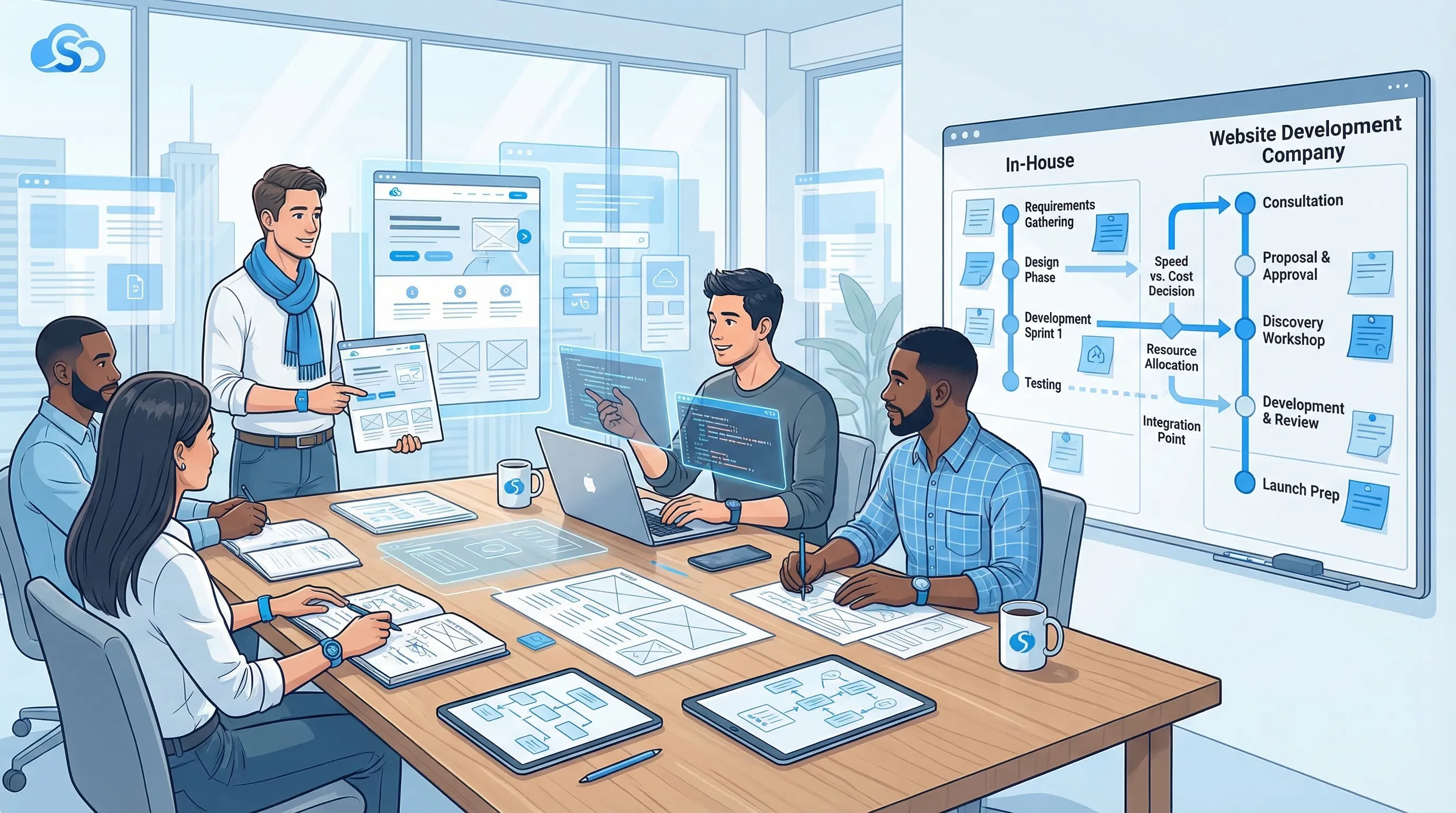
Choosing between a website development company and an in-house team is rarely about “which is better.” For SaaS teams, it is usually about how fast you need impact, how often you will iterate, and what kind of work you are actually shipping (marketing site, docs, app shell, interactive tools, experiments).
This guide breaks down cost and speed tradeoffs in a way you can use for planning, budgeting, and avoiding the most common timeline traps.
First, define “website development” for your SaaS
A lot of build vs buy debates get fuzzy because “the website” can mean very different things:
- Marketing site: homepage, pricing, use cases, landing pages, SEO content, comparison pages
- Docs and help center: information architecture, search, performance, UX for problem resolution
- Auth flows and app shell: signup/login, billing portal entry points, account settings pages
- Growth experiments: A/B tests, personalization, dynamic content, interactive calculators
A website development company can be extremely fast for a bounded project (rebuild, migration, rebrand). In-house tends to win when the site is a living growth surface with weekly iterations.
If you skip this step, you will compare the wrong costs, and you will optimize for speed in the wrong place.
Cost: what you pay vs what it really costs
The headline numbers, like “agency project fee” vs “developer salary,” are not the full story. The decision becomes clearer when you separate one-time build costs from ongoing iteration costs.
Cost components you should model
Use this table as a checklist when you estimate total cost of ownership.
| Cost component | Website development company (external) | In-house team |
|---|---|---|
| Getting started | Sales cycle, scoping, kickoff | Hiring, onboarding, internal alignment |
| Direct cost | Project fee or retainer (sometimes plus change requests) | Salary, benefits, payroll taxes |
| Management overhead | Vendor management, reviews, approvals | Engineering management, career ladders, performance reviews |
| Tooling and ops | Sometimes included, sometimes extra | Dev tooling, monitoring, CI/CD, environments |
| Knowledge retention | Risk of losing context after handoff | Strong, context stays with team |
| Flexibility | Great for spikes, slower for frequent small changes | Great for continuous iteration |
| Risk surface | Contract risk, dependency on vendor | Hiring risk, retention risk |
A practical way to think about it:
- External teams price the uncertainty into the contract. You pay for speed, packaging, and risk transfer.
- In-house teams amortize knowledge over time. You pay more “every month,” but iteration gets cheaper and faster.
Typical cost ranges (use as planning bands, not quotes)
Costs vary massively by geography, seniority, scope, and stack. These bands are useful for back-of-the-napkin planning.
| Scenario | Common market range | Notes |
|---|---|---|
| Marketing site redesign (basic to mid complexity) | $15k to $80k | Copy, design system maturity, CMS choice, and number of templates drive variance |
| Ongoing agency support (small retainer) | $2k to $15k per month | Often covers a fixed number of hours, SLAs, and small improvements |
| One experienced web engineer in-house (US market) | Often $120k to $220k base salary | Fully loaded cost is typically higher once you include benefits and overhead |
For salary context, the US Bureau of Labor Statistics publishes pay data for software developers (use it as a baseline, then adjust for your role and market): BLS Software Developers.
The hidden cost that decides it: opportunity cost
For SaaS, the real cost is often what you delay:
- A pricing page refresh that could lift trial starts
- A faster page speed project that could lift SEO and paid conversion
- A new “security” section that helps unblock enterprise deals
- A comparison page strategy that captures high intent traffic
If your in-house team is already maxed out on product delivery, “free” internal execution can be the most expensive option.
Speed: time-to-start vs time-to-ship vs time-to-iterate
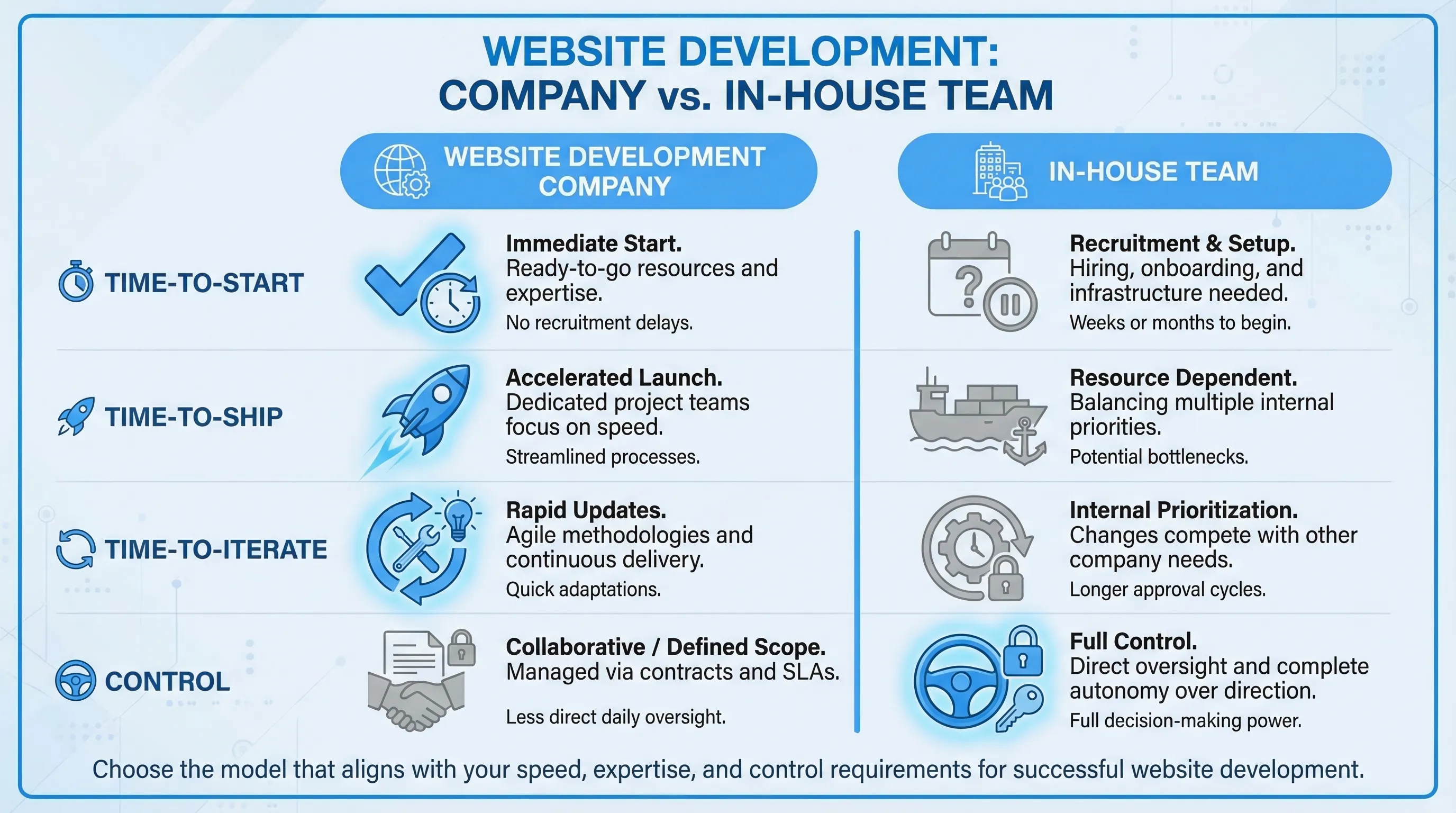
Most teams only compare “how quickly can we launch the new site.” Speed has three layers:
- Time-to-start: how long until work begins
- Time-to-ship: how long until a quality release goes live
- Time-to-iterate: how quickly you can make small improvements after launch
Speed comparison in practice
| Speed dimension | Website development company | In-house |
|---|---|---|
| Time-to-start | Often fast once scoped (days to a couple weeks) | Hiring or freeing capacity can take weeks to months |
| Time-to-ship (single project) | Strong if scope is clear and approvals are fast | Strong if team already exists and knows the stack |
| Time-to-iterate (weekly improvements) | Can be slower due to queueing and change orders | Usually faster because context is local |
| Cross-functional coordination | Medium, requires structured reviews | High, easier to align with product and marketing |
The common pattern:
- External wins on time-to-start.
- In-house wins on time-to-iterate.
The biggest speed killer is not engineering
For marketing sites, teams usually underestimate:
- Content readiness (final copy, screenshots, legal review)
- Analytics and tracking plan (events, pixels, privacy, consent)
- SEO requirements (redirect maps, internal linking, canonical rules)
- Stakeholder approvals (founder review loops, brand, product, legal)
A great agency cannot ship a site if your pricing page copy is still in a Google Doc with unresolved comments.
When a website development company is the faster, cheaper choice
External teams tend to win when the work is bounded, specialized, or time-sensitive.
1) You are doing a “big bang” event
Examples:
- Rebrand with new design system
- CMS migration (for example, moving from a custom build to a modern CMS)
- Major information architecture changes for SEO
If you need a coordinated push across design, content, front-end, and implementation, a website development company can compress timelines by staffing multiple specialists in parallel.
2) You need skills you will not need after launch
Short-term specialists can make sense for:
- Technical SEO migrations (redirect mapping, crawl management)
- Accessibility remediation (WCAG-oriented audits and fixes)
- Performance work tied to Core Web Vitals
If you do not plan to maintain those capabilities, hiring is expensive and slow.
3) Your in-house team is product-constrained
This is common in early and mid-stage SaaS:
- Engineering is focused on roadmap delivery and reliability
- Marketing needs landing pages and experimentation velocity
In that case, outsourcing the marketing site can be the “speed unlock,” even if it is not the cheapest line item.
When in-house is faster (even if it looks more expensive)
In-house tends to win when your website is tightly coupled to product strategy and needs ongoing iteration.
1) Your website is a growth machine, not a brochure
If you run:
- Weekly landing page experiments
- Personalization by segment (SMB vs enterprise, industry, paid vs organic)
- Consistent conversion optimization cycles
…then in-house can ship faster because context is always available and small changes do not require vendor scheduling.
2) You have many “small but important” requests
Examples:
- Add one new customer story template
- Update pricing FAQ logic (without rewriting the whole page)
- Launch a new integration page every week
Agencies can do these, but you can burn time in handoffs, brief writing, and approvals. In-house teams reduce coordination tax.
3) Your site touches sensitive systems
If your marketing site interacts with:
- Account data
- Billing or entitlements
- Enterprise security requirements
…you may prefer in-house control for security review, code ownership, and incident response. (Many agencies can meet high security bars, but your procurement and review cycles may erase any speed advantage.)
The hybrid model most SaaS teams end up using
A practical approach for many teams:
- In-house owns the “always-on” surfaces: templates, experimentation framework, analytics, performance budgets
- A website development company handles spikes: redesigns, migrations, campaign bursts, specialized audits
This reduces hiring pressure while keeping iteration fast.
The key is to avoid a messy boundary. Decide who owns:
- Design system components
- CMS structure and content models
- Deployment pipeline and environments
- Tracking plan and data governance
If ownership is unclear, hybrid becomes the slowest option.
A decision framework you can use in 30 minutes
Instead of arguing from preferences, score your situation.
Step 1: classify the work
Pick the closest match:
- Project: a defined build with a clear end date (new marketing site, rebrand)
- Program: ongoing improvements with steady cadence (conversion optimization, SEO content ops)
Projects lean external, programs lean in-house.
Step 2: score your constraints
| Constraint | If this is true, it pushes you toward… | Why |
|---|---|---|
| You need to launch in under 6 to 8 weeks | Website development company | Faster time-to-start and parallel staffing |
| You expect weekly iterations after launch | In-house | Lower coordination overhead for small changes |
| Your marketing site is a core acquisition channel | In-house or hybrid | You want compounding learning and faster experiments |
| You lack web performance, SEO migration, or accessibility expertise | Website development company | Buy specialized capability when you need it |
| Engineering is already saturated | Website development company or hybrid | Avoid roadmap tradeoffs |
| You have strong product marketing + design but weak execution capacity | Website development company | Execution becomes the bottleneck |
Step 3: decide based on the “second launch”
Many teams can get to launch #1 with either model.
The real question is: who will own launch #2, launch #3, and the 20 small fixes you discover after real traffic hits the new site?
If the answer is “we do not know,” you will likely pay for it in speed later.
How to protect cost and speed (whichever route you pick)
These are the practices that reduce rework and prevent timeline surprises.
Make scope measurable, not aspirational
Bad scope: “modern, conversion-focused redesign.”
Better scope:
- Page inventory and templates (how many unique layouts)
- CMS requirements (who edits what, approvals, versioning)
- Performance targets (for example, keep added scripts non-blocking)
- Analytics plan (events you must capture on day one)
- Redirect map ownership (who builds it, who validates it)
A website development company can move quickly when scope is testable.
Get content and approvals ready early
If marketing owns content, set a “content freeze” date. If founders must approve, schedule reviews in advance.
A simple rule: your engineering timeline will be only as fast as your content readiness timeline.
Treat the handoff as a product
If you outsource, your handoff should include:
- Repo access and deployment docs
- How to add a new page template
- Component library usage rules
- Performance and SEO notes
- A clear bug fix window (post-launch warranty period)
If you build in-house, document enough that you can onboard the next hire without slowing to a crawl.
Build a feedback loop into the website itself
The fastest teams do not rely on internal opinions alone after launch. They collect user signal directly:
- “What stopped you from signing up today?” on pricing
- “Did this page answer your question?” on docs
- “What are you comparing us to?” on comparison pages
If developer bandwidth is tight, a lightweight widget can help you ship this feedback loop without turning it into a full engineering project.
Modalcast is built for that use case: one simple widget that can collect feedback, share updates, capture leads, and promote offers without adding a complex stack. If you want a concrete example of speed-to-launch, see how to ship a feedback website tool in 15 minutes.
Practical examples (so you can map this to your situation)
Example A: early-stage SaaS rebrand with a deadline
- Constraint: “We need a new site live before a launch announcement.”
- Reality: engineering is heads down on the product.
A website development company usually wins because you can run parallel workstreams (design, implementation, QA). In-house can still work if you already have a web engineer dedicated to marketing, but most early teams do not.
Example B: series A SaaS optimizing conversion every week
- Constraint: “We need to improve signup conversion, not just redesign.”
- Reality: you will run frequent experiments, refine positioning, and ship new integration pages.
In-house or hybrid usually wins. The compounding benefit is speed-to-iterate and learning retention.
Example C: mature SaaS migrating docs and fixing discoverability
- Constraint: “Our docs are harming support load and churn.”
- Reality: information architecture, search, and content governance are the hard parts.
A hybrid can be ideal: external help for information architecture and migration mechanics, in-house ownership for ongoing docs quality and UX improvements.
Bottom line
If your priority is speed to a defined launch and the work is a bounded project, a website development company can be the fastest path, often with predictable delivery.
If your priority is speed of continuous iteration and your website is a core growth lever, in-house usually wins over time, even when the monthly cost looks higher.
And in both models, the teams that move fastest build an on-site feedback loop so real users can tell them what is unclear, broken, or missing. That signal is what makes your second and third launch meaningfully better than the first.